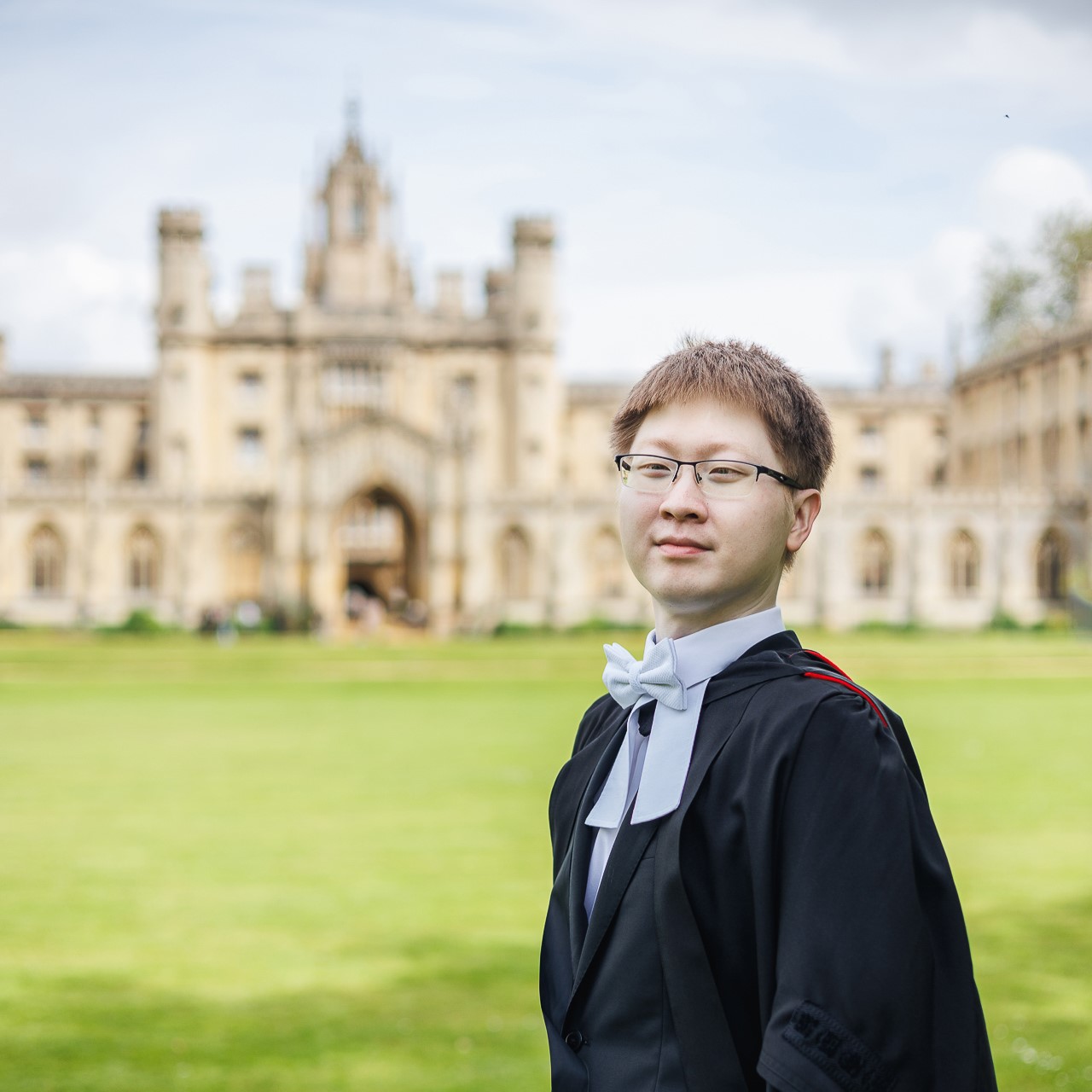
I am Weizhe Lin, a Research Scientist at Huawei’s Noah’s Research Institute, where I work on Agentic RL, deep research and cowork agents, and agent inference acceleration.
I received my Ph.D. in Engineering from the University of Cambridge in November 2024, supervised by Prof. Bill Byrne. My doctoral research focused on multimodal retrieval and question answering. I also collaborate with the Stranks Lab at Cambridge on computer vision methods for materials research.
Before Cambridge, I studied computer science at the University of Hong Kong for one year. I received my B.A. and M.Eng. from Cambridge in June 2021 and my M.A. in May 2024. During my undergraduate studies, I received the Trinity Overseas Bursary and the Cambridge Trust Scholarship.
I joined Huawei’s Advanced Computing and Storage Lab in December 2024 and moved to Noah’s Research Institute in September 2026.
We are recruiting: We welcome applications from people interested in AI agents, agentic reinforcement learning, and efficient inference. Please send your CV to linweizhe1@huawei.com.
Research interests: Agentic reinforcement learning, inference optimization and acceleration, multimodal retrieval, question answering, diffusion models, dialogue systems, recommender systems, graph neural networks, and multi-robot path planning.
Education
Trinity College, University of Cambridge 2021 - 2024
Ph.D. in Engineering (supervised by Prof. Bill Byrne)
Visiting Ph.D. research in Chemical Engineering and Biotechnology (supervised by Prof. Samuel Stranks)
Trinity College, University of Cambridge 2017 - 2021
M.Eng. and B.A. in Information Engineering
Master’s dissertation:
- Graph Neural Networks in Multi-Domain Task-Oriented Systems (Distinction and Outstanding Project Prize)
University of Hong Kong 2016 - 2017
Undergraduate study in Computer Science (B.Eng. program)
Work Experience
- Research Scientist, Huawei Noah’s Research Institute (2026–present)
- Develop agentic reinforcement learning methods for long-horizon tasks.
- Prepare and curate data for search and collaborative agents.
- Accelerate and optimize agent inference through context compression, agent routing, KV cache management, and speculative decoding.
- Research Scientist, Huawei Advanced Computing and Storage Lab (2024–2026)
- Optimized AI inference systems.
- Developed algorithms to accelerate LLM inference.
- Group Lead, X-Intelligence Labs Research (2024)
- Developed machine learning methods for long-term contextual memory in AI systems.
- CTO, To0space, Beijing (2023–2024)
- Led the research team.
- Developed generative AI solutions for architectural design.
- To0space Website
- Applied Scientist II Intern, Amazon Development Center, Cambridge (2022)
- Developed models for table question answering.
- Research Intern, Microsoft Software Technology Center, Beijing (2021)
- Developed movie recommender systems.
- Prepared and maintained movie recommendation datasets.
- Remote Researcher, Computer Laboratory, University of Cambridge (2020)
- Proposed a decentralized deep learning framework using graph attention networks for multi-agent path planning.
- Demonstrated generalization from simple training instances to substantially larger problems, scaling the number of agents and map size by up to 100×.
- Researcher, Computer Laboratory, University of Cambridge (2019)
- Proposed a neural network framework for multimodal feature fusion to support psychological disorder prediction.
- Developed a system for detecting self-adaptors (fidgeting) and investigated its use in automated detection of psychological distress.
- Cloud Engineering Intern, Informetis Europe Ltd. (2018)
- Developed a Django web application to track data from IoT power monitors, supporting machine learning models that estimate energy use by individual appliances.
- Managed data using MySQL, Google Bigtable, and Redis caching.
Publications and Presentations
- [arXiv 2026] Wenbo Gao, Zhaomou Song, Zhiyuan Ji, Renxi Liu, Xing Li, Xianzhi Yu, Xiaoguang Li, James Chung-wai Cheung, Weizhe Lin, Yaoyuan Wang. Experience Funnel: A State-Policy Alternating Loop for Self-Evolving Agents. Read
- [Proceedings of the IEEE 2026] Zihong He, Weizhe Lin (Corresponding author), Hao Zheng, Fan Zhang, Matt W. Jones, Laurence Aitchison, Xuhai Xu, Miao Liu, Hai-Ning Liang, Per Ola Kristensson, Junxiao Shen. Human-Inspired Perspectives: A Survey on AI Long-Term Memory. Read
- [ACL 2026] Pengxiang Zhao, Hui-Ling Zhen, Xing Li, Han Bao, Weizhe Lin, Zhiyuan Yang, Yu Zi Wei, Xin Wang, Mingxuan Yuan, Xianzhi Yu, Zhenhua Dong. Unleashing Low-Bit Inference on Ascend NPUs: A Comprehensive Evaluation of HiFloat Formats. Read
- [ACL 2026] Guangyu Yang, Jinghong Chen, Jingbiao Mei, Weizhe Lin, Bill Byrne. Retrieval-Augmented Defense: Adaptive and Controllable Jailbreak Prevention for Large Language Models. Read
- [NeurIPS 2026] Shengyin Sun, Yiming Li, Renxi Liu, Xinqi Li, Hui-Ling Zhen, Weizhe Lin, Chen Chen, Xianzhi Yu, Mingxuan Yuan, Chen Ma. PSD: Pushing the Pareto Frontier of Diffusion LLMs via Parallel Speculative Decoding. Read
- [ICLR 2026] Weizhe Lin, Xing Li, Zhiyuan Yang, Xiaojin Fu, Huiling Zhen, Yaoyuan Wang, Xianzhi Yu, Wulong Liu, Xiaosong Li, Mingxuan Yuan. TrimR: Verifier-based Training-Free Thinking Trimming for Efficient Test-Time Scaling. Read
- [ICLR 2026] Shengyin Sun, Yiming Li, Xing Li, Yingzhao Lian, Weizhe Lin, Huiling Zhen, Zhiyuan Yang, Xianzhi Yu, Chen Chen, Mingxuan Yuan, Chen Ma. Scaling Up, Speeding Up: A Benchmark of Speculative Decoding for Efficient LLM Test-Time Scaling. Read
- [arXiv 2026] Wenbo Gao, Renxi Liu, Xian Wang, Fang Guo, Shuai Yang, Xi Chen, Hui-Ling Zhen, Hanting Chen, Weizhe Lin, Xiaosong Li, Yaoyuan Wang. AgentCollab: A Self-Evaluation-Driven Collaboration Paradigm for Efficient LLM Agents. Read
- [NeurIPS 2026] Zehua Pei, Hui-Ling Zhen, Weizhe Lin, Sinno Jialin Pan, Yunhe Wang, Mingxuan Yuan, Bei Yu. MemDLM: Memory-Enhanced DLM Training. Read
- [Technical Report 2026] Huiling Zhen, Weizhe Lin (equal contribution), Renxi Liu, Kai Han, Yiming Li, Yuchuan Tian, Hanting Chen, Xiaoguang Li, Xiaosong Li, Chen Chen, Xianzhi Yu, Mingxuan Yuan, Youliang Yan, Peifeng Qin, Jun Wang, Yu Wang, Dacheng Tao, Yunhe Wang. DLLM Agent: See Farther, Run Faster. Read
- [EMNLP 2026] Shengyin Sun, Yiming Li, Renxi Liu, Weizhe Lin, Hui-Ling Zhen, Xianzhi Yu, Mingxuan Yuan, Chen Ma. JuDi: Revisiting Judge Decoding from First Principles via Training-Free Distributional Divergence. Read
- [arXiv 2026] Fan Bai, Pai Peng, Zhengzhi Tang, Zhe Wang, Gong Chen, Xiang Lu, Yinuo Li, Huan Lin, Weizhe Lin, Yaoyuan Wang, Xiaosong Li. EPD-Serve: A Flexible Multimodal EPD Disaggregation Inference Serving System On Ascend. Read
- [NeurIPS 2025] Jinghong Chen, Guangyu Yang, Weizhe Lin, Jingbiao Mei, Chenxu Lyu, Bill Byrne. On Extending Direct Preference Optimization to Accommodate Ties. Read
- [arXiv 2025] Weizhe Lin, Hui-Ling Zhen, Shuai Yang, Xian Wang, Renxi Liu, Hanting Chen, Wangze Zhang, Chuansai Zhou, Yiming Li, Chen Chen, Xing Li, Zhiyuan Yang, Xiaosong Li, Xianzhi Yu, Zhenhua Dong, Mingxuan Yuan, Yunhe Wang. Towards Efficient Agents: A Co-Design of Inference Architecture and System. Read
- [EMNLP 2025] Jingbiao Mei, Jinghong Chen, Guangyu Yang, Weizhe Lin, Bill Byrne. Robust Adaptation of Large Multimodal Models for Retrieval Augmented Hateful Meme Detection. Read
- [Technical Report 2025] Huawei Pangu Team. Pangu Pro MoE: Mixture of Grouped Experts for Efficient Sparsity. Read
- [EMNLP 2025] Wenqi Zhou, Kai Cao, Hao Zheng, Yunze Liu, Xinyi Zheng, Miao Liu, Per Ola Kristensson, Walterio W. Mayol-Cuevas, Fan Zhang, Weizhe Lin (Corresponding author), Junxiao Shen. X-LeBench: A Benchmark for Extremely Long Egocentric Video Understanding. Read
- [Technical Report 2025] OpenPangu Team. OpenPangu DeepDiver-v2: Multi-agent Learning for Deep Information Seeking. Read
- [ICCV 2025] Xinyi Zheng, Steve Zhang, Weizhe Lin (Corresponding author), Aaron Zhang, Walterio W Mayol-Cuevas, Yunze Liu, Junxiao Shen. CULTURE3D: A Large-Scale and Diverse Dataset of Cultural Landmarks and Terrains for Gaussian-Based Scene Rendering. Read
- [arXiv 2024] Weizhe Lin, Junxiao Shen. Lucia: A Temporal Computing Platform for Contextual Intelligence. Read
- [Ph.D. Thesis 2024] Weizhe Lin. Augmenting Multi-modal Question Answering Systems with Retrieval Methods. Read
- [ACL 2024] Jingbiao Mei, Jinghong Chen, Weizhe Lin, Bill Byrne, Marcus Tomalin. Improving Hateful Meme Detection through Retrieval-Guided Contrastive Learning. Read
- [ACL 2024] Weizhe Lin, Jingbiao Mei, Jinghong Chen, Bill Byrne. PreFLMR: Scaling Up Fine-Grained Late-Interaction Multi-modal Retrievers. Read
- [NAACL 2024] Jinghong Chen, Weizhe Lin, Jingbiao Mei, Bill Byrne. Control-DAG: Constrained Decoding for Non-Autoregressive Directed Acyclic T5 using Weighted Finite State Automata. Read
- [NAACL 2024] Guangyu Yang, Jinghong Chen, Weizhe Lin, Bill Byrne. Direct Preference Optimization for Neural Machine Translation with Minimum Bayes Risk Decoding. Read
- [NeurIPS 2023] Weizhe Lin, Jinghong Chen, Jingbiao Mei, Alexandru Coca, Bill Byrne. Fine-grained Late-interaction Multi-modal Retrieval for Retrieval Augmented Visual Question Answering. Read
- [Nature Machine Intelligence 2023] Kangyu Ji, Weizhe Lin, Yuqi Sun, Lin-Song Cui, Javad Shamsi, Yu-Hsien Chiang, Jiawei Chen, Elizabeth M. Tennyson, Linjie Dai, Qingbiao Li, Kyle Frohna, Miguel Anaya, Neil C. Greenham, Samuel D. Stranks. Self-supervised deep learning for tracking degradation of perovskite light-emitting diodes with multispectral imaging. Read Data
- [SIGDIAL 2023 Best Long Paper] Alexandru Coca, Bo-Hsiang Tseng, Jinghong Chen, Weizhe Lin, Weixuan Zhang, Tisha Anders, Bill Byrne. Grounding Description-Driven Dialogue State Trackers with Knowledge-Seeking Turns. Read
- [ACL 2023] Weizhe Lin, Rexhina Blloshmi, Bill Byrne, Adrià de Gispert, Gonzalo Iglesias. An Inner Table Retriever for Robust Table Question Answering. Read
- [ACL 2023] Weizhe Lin, Rexhina Blloshmi, Bill Byrne, Adrià de Gispert, Gonzalo Iglesias. LI-RAGE: Late Interaction Retrieval Augmented Generation with Explicit Signals for Open-Domain Table Question Answering. Read
- [EACL 2023] Weizhe Lin, Zhilin Wang, Bill Byrne. FVQA 2.0: Introducing Adversarial Samples into Fact-based Visual Question Answering. Read
- [EACL 2023] Alexandru Coca, Bo-Hsiang Tseng, Weizhe Lin, Bill Byrne. More Robust Schema-Guided Dialogue State Tracking via Tree-Based Paraphrase Ranking. Read
- [arXiv 2023] Jinghong Chen, Weizhe Lin, Bill Byrne. Schema-Guided Semantic Accuracy: Faithfulness in Task-Oriented Dialogue Response Generation. Read
- [IEEE Transactions on Affective Computing 2023] Weizhe Lin, Indigo Orton, Qingbiao Li, Gabriela Pavarini, Marwa Mahmoud. Looking at the Body: Automatic Analysis of Body Gestures and Self-Adaptors in Psychological Distress. Read
- [EMNLP 2022] Weizhe Lin, Bill Byrne. Retrieval Augmented Visual Question Answering with Outside Knowledge. Read
- [KaRS 2022] Weizhe Lin, Linjun Shou, Ming Gong, Jian Pei, Zhilin Wang, Bill Byrne, Daxin Jiang. Transformer-Empowered Content-Aware Collaborative Filtering. Read
- [KaRS 2022] Weizhe Lin, Linjun Shou, Ming Gong, Jian Pei, Zhilin Wang, Bill Byrne, Daxin Jiang. Combining Unstructured Content and Knowledge Graphs into Recommendation Datasets. Read
- [EMNLP 2021] Weizhe Lin, Bo-Hsiang Tseng, Bill Byrne. Knowledge-Aware Graph-Enhanced GPT-2 for Dialogue State Tracking. Read
- [IEEE Robotics and Automation Letters 2021] Qingbiao Li (equal contribution), Weizhe Lin (equal contribution), Zhe Liu, Amanda Prorok. Message-Aware Graph Attention Networks for Large-Scale Multi-Robot Path Planning. Read
- [Nature Machine Intelligence 2021] Michael Roberts, Derek Driggs, Matthew Thorpe, et al. Weizhe Lin (collaborative author). Common pitfalls and recommendations for using machine learning to detect and prognosticate for COVID-19 using chest radiographs and CT scans. Read
- [NAACL Workshop WNU 2021] Zhilin Wang, Weizhe Lin, Xiaodong Wu. Learning Similarity between Movie Characters and Its Potential Implications on Understanding Human Experiences. Read
- [FG 2020 Oral] Ziheng Zhang, Weizhe Lin, Mingyu Liu, Marwa Mahmoud. Multimodal Deep Learning Framework for Mental Disorder Recognition. Read
- [FG 2020 Oral] Weizhe Lin, Indigo Orton, Mingyu Liu, Marwa Mahmoud. Automatic Detection of Self-Adaptors for Psychological Distress. Read
- [arXiv 2020] Xiaodong Wu (equal contribution), Weizhe Lin (equal contribution), Zhilin Wang, Elena Rastorgueva. Author2Vec: A Framework for Generating User Embedding. Read
- [EMNLP Workshop W-NUT 2019] Zhilin Wang, Elena Rastorgueva, Weizhe Lin, Xiaodong Wu. No, you’re not alone: A better way to find people with similar experiences on Reddit. Read
- [Cambridge Language Sciences ECR Symposium 2019] Zhilin Wang, Xiaodong Wu, Weizhe Lin, Elena Rastorgueva. Detecting personal attributes through analyzing online forums. Read
Academic Service
- Area Chair: EMNLP Industry Track
- Reviewer: EMNLP, ACL, EACL, NAACL, COLING, and other NLP venues
- Reviewer: IEEE Transactions on Pattern Analysis and Machine Intelligence
- Reviewer: The First Workshop on Interactive Technologies for AI in Healthcare: Diagnosis, Management, and Assistance
- Reviewer: The First Workshop on Multimodal Data for Mental Disorder Recognition
Community Activities
- Director of Web Development, Cambridge Hercules
- Data Analysis Mentor, Bridge for Enterprise
- Computer Vision Team Member, Robotics Society (Cambridge)
Projects
Multimodal Retrieval-Augmented Systems (Ph.D. Research)
- Supervised by Prof. Bill Byrne.
- Developed multimodal retrieval-augmented systems for knowledge-based visual question answering and table question answering.
Knowledge-Aware Multi-Domain Task-Oriented Dialogue Systems (Master’s Dissertation)
- Supervised by Prof. Bill Byrne, Head of Information Engineering.
- Applied graph neural networks to task-oriented dialogue systems.
Multi-Robot Path Planning
- Supervised by Amanda Prorok.
- Used imitation learning and graph neural networks to enable communication between agents.
- Applied graph attention networks to improve coordinated navigation toward agents’ goals.
COVID-19 Diagnosis Support and CT Denoising (AIXCOVNET Project Support Member)
- Collaborated with the Stranks Lab at the Cavendish Laboratory and the Department of Radiology at Addenbrooke’s Hospital, supervised by Prof. Samuel Stranks.
- Denoised CT scans of COVID-19 and other common lung diseases.
- Supported research on low-dose, high-speed CT screening.
Deep Learning for Hyperspectral Microscopy Image Reconstruction
- Collaborated with the Stranks Lab and the VISION Laboratory in the Department of Physics, supervised by Prof. Samuel Stranks.
- Developed machine learning methods for denoising and physics-informed reconstruction of microscopy images.
- Reduced the laser exposure time required for imaging in physics and materials research.
Automatic Fidgeting and Self-Adaptor Detection for Psychological Distress from 2D Videos Code
- Developed an automated system to detect fidgeting, including face touching and rhythmic body movements, supervised by Dr. Marwa Mahmoud.
- Used Gaussian mixture models and Fisher vectors for feature fusion and dimensionality reduction.
- Classified behavior using multimodal features extracted from interview videos.
LearnAh.uk
- Designed the frontend and backend and managed the database.
- Helped teachers find relevant popular science videos using text analysis with latent semantic indexing and latent Dirichlet allocation.
- Deployed the service as a Django web application with a REST API for third-party access.
- Graduate of the UCL Institute of Education Knowledge Lab’s EDUCATE program, supported by an EU grant.
- Y Combinator Startup School graduate.
- Runner-up in the Social Enterprise category of the Cambridge University Entrepreneurs competition.
Mars Lander Design and Programming Contest: Airbus Defense and Space Prize Code
I developed an autopilot that accounted for planetary rotation and wind and could insert the lander into orbits with specified apogees and perigees. I also explored optimal control to reduce peak acceleration or descent time and accommodate engine lag and delay. The project received a prize from Airbus Defense and Space, followed by an invitation to visit its Stevenage site.
EasyEye (HackCambridge 2019) Code
We built an OpenCV system that used a laptop camera to monitor blinking and squinting as indicators of eye fatigue. The system uploaded observations to an online database for server-side analysis and sent vibration and sound alerts to the user’s Fitbit watch.
Robotics Society Computer Vision Subteam Task: RMRC Motion Detection Code
- Developed a Python and OpenCV algorithm to detect and count black objects moving against a white background, combining hue-based detection with frame differencing.
Arm Hackathon Machine Learning Project: Wearable Mbed Code
We built an Mbed wearable that collected acceleration data and used machine learning to recognize activities such as resting, walking, running, and typing. Recorded activity data helped users understand their daily routines and track changes over time.
Wi-Fi Guard Code
- Patent number: 2016SR049201 (China).
- Developed an Android application that monitored data usage to prevent excessive background traffic.
- Third place in the Computer Science category of the 15th Awards Program for Future Scientists (national).
Virus Protection Assistant Code
- Developed a behavior-based antivirus application with 10 modules and more than 100,000 lines of code.
- Gold medal at the 30th Fujian Adolescents Science & Technology Innovation Contest, China.
Other Awards
- Airbus Defense and Space Prize, Mars Lander Design and Programming Contest, 2018 (runner-up)
- Centenary Prize for a top-three final-year project in Information, Electrical and Electronics Engineering
- Chinese Physics Olympiad (Fujian Division) — second prize
- Hong Kong Pan Pearl River Delta Physics Olympics — third prize
- Fujian Adolescents Science & Technology Innovation Contest — gold medal (30th), third prize (29th)
- 15th Awards Program for Future Scientists — silver medal